But now apart from the law the righteousness of God has been made known, to which the Law and the Prophets testify. This righteousness is given through faith in Jesus Christ to all who believe. Romans 3:21-22
Given, Not Gained
We are wired to earn our keep. From the classroom to the workplace, the world operates with a simple, unbreakable rule: you get what you earn. And our fallen flesh assumes God’s kingdom must work the same way. We look at God’s holy law and view it as a ladder we must climb to achieve his favor. We think we can gain his favor through better behavior, deeper sincerity, or more fervent promises to “do better next time.”
But the law was never meant to be a ladder; it’s a mirror. It reflects our profound inability to be holy, showing us that our best efforts are stained with sin. If our standing before God relied on what we can gain through our own obedience, we would be utterly lost.
But then Saint Paul was inspired to write two wonderful words, “But now,” which announce a radical shift. A righteousness (perfection) from God has been revealed entirely apart from our law-keeping. It’s not a wage gained by our work; it’s a freely given reward to the spiritually bankrupt. This was always God’s plan, proclaimed throughout the Old Testament. God demands absolute perfection from us. And then, through his Son, Jesus Christ, he gives us exactly what he demands.
Jesus lived the spotless life you could not live, fulfilling God’s law in your place. He suffered the penalty for your failures on the cross. His perfect record has been transferred to your account. Notice the crucial verb in Paul’s explanation: this righteousness is given. You can’t gain what you’ve already been given through faith in Jesus.
Understand: faith isn’t your contribution to salvation. It isn’t a good work that tips the scales in your favor. It’s simply the empty hand of a beggar receiving a gift purchased with Jesus’ blood. You don’t have to gain God’s love today or ever. In Jesus, it’s already been given.
Prayer:
Lord Jesus, thank you for fulfilling the law in my place. When I am tempted to rely on my own works, quiet my proud heart and point me to you. Grant me the confidence of knowing that your perfection is fully given to me. Amen.
Now we know that whatever the law says, it says to those who are under the law, so that every mouth may be silenced and the whole world held accountable to God. Therefore no one will be declared righteous in God’s sight by the works of the law; rather, through the law we become conscious of our sin. Romans 3:19-20
We’ve Had a Problem
On April 13, 1970, an oxygen tank exploded aboard the Apollo 13 spacecraft. Drifting into the dark vacuum of space, the crew faced a catastrophic systems failure. Their oxygen was escaping into space, and their power was rapidly draining. The radio crackled with a now-historic phrase: “Houston, we’ve had a problem.”
Those astronauts couldn’t save themselves. They couldn’t step out and piece the spacecraft back together. If they had been forced to rely on their own resources, they would have been doomed.
The apostle Paul issues a similar, terrifying diagnostic report for you and me. By nature, we like to think we can navigate our own way to heaven. We assume the law—God’s holy commandments—is a step-by-step flight manual to manage a safe landing there.
But Paul shatters that illusion. God’s law was not intended to save sinners. It was given so that “every mouth may be silenced and the whole world held accountable to God.” It’s a master warning alarm flashing aggressively on our spiritual control panel. It can’t fix our broken condition; it simply tells us there’s a problem. “Through the law we become conscious of our sin.”
When we honestly measure ourselves against God’s holy demands, our self-righteous defenses crumble. Our mouths shut. We realize our spiritual oxygen is completely depleted. We have a problem. We can’t fix it.
But our rescue doesn’t depend on us. Just as the Apollo Crew had to rely entirely on Mission Control to get them home, we rely entirely on God’s rescue mission in Jesus. Our Savior stepped into our doomed vessel, lived perfectly under God’s law in our place, suffered the fatal consequences of our sin on the cross, and rose victorious to bring us safely home. God’s law only diagnoses and condemns; Jesus gives life.
When the law silences your excuses, don’t despair. Look to Jesus. The problem is fatal, but your Savior has already rescued you.
Prayer:
Jesus, help me see how helpless I am, and empower me to cling to you now and forever. Amen.
[Jesus said] I am sending you out like sheep among wolves. Therefore be as shrewd as snakes and as innocent as doves. Matthew 10:16
Being Sheep Among Wolves
Sheep among wolves are vulnerable, and they must depend on the protection of the shepherd. The Lord says, “As a shepherd looks after his scattered flock when he is with them, so will I look after my sheep” (Ezekiel 34:12). We live each day trusting that Jesus, our ever-present and almighty God will safely lead us and completely provide for us.
But this dependence on the Shepherd is not the only way God wants us to live as his followers. Jesus urged the disciples to be cunning, resourceful, and use every gift they had at their disposal. Human reason, for example, is a useful tool God has given us, but we must remember that reason is only a tool and does not supplant faith in God’s revealed truth in the Bible.
Jesus also urges his disciples to be “innocent as doves.” “Innocent” is the same word used in Romans 16:19 “be innocent about what is evil,” and Philippians 2:15 “so that you may become blameless and pure, children of God.” We are not to be mixed with sin. But with the help of the Holy Spirit, we strive to lead lives that are blameless and pure in the eyes of God.
That’s a lot to live up to: have a pure life, be cunning and shrewd about the world and about spreading the gospel, yet be sheep among wolves. How can we do it? Never perfectly, that’s for certain. Which is why we needed Jesus to rescue us from those times when we have not lived up to God’s perfect standard. Thankfully, Jesus has done just that. And now, with the help of the Holy Spirit, whom Jesus sends into our hearts, we are enabled to daily put to death the sinful nature with which we were born, and to be “eager to do what is good” (Titus 2:14).
Prayer:
Thank you, Jesus, for protecting me from the spiritual wolves that surround me. Amen.
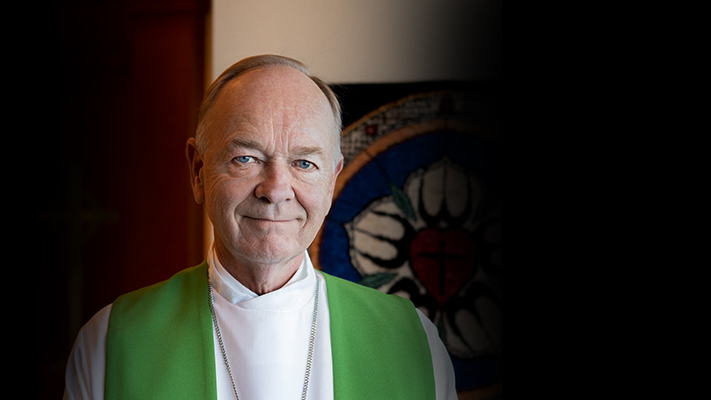
Women serve in world missions In the same way that women actively served in the work of the early Christian church, WELS is using women’s gifts to share the gospel with other women in situations […]
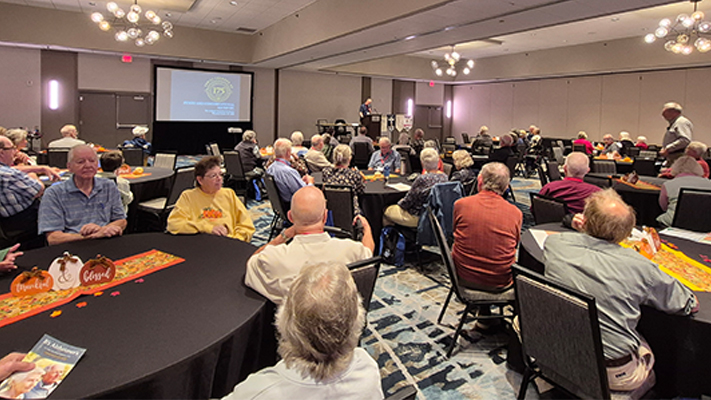
Organization of WELS Lutheran Seniors dissolves corporation “Closing down [an] organization isn’t failure; it is just a symptom of the laws of organizations. Organizations have a life span.” Retired Pastor Mark Jeske passed along that observation in […]
»
Evangelical Lutheran Confessional Forum meets The biennial meeting of the Evangelical Lutheran Confessional Forum, which consists of leaders of WELS and the Evangelical Lutheran Synod (ELS), took place October 19-20, 2026, at the WELS Center […]
»
Upcoming webinar offers tips for intentional ministry recruitment On Nov. 11, 2026, at 7 p.m. Central, WELS’ five ministry recruitment counselors will be hosting a webinar called “Generational Differences and Ministry Recruitment: The INVEST Framework.” Using the acrostic […]
15 What then? Should we continue to sin, because we are not under law but under grace? Absolutely not! 16 Do you not know that when you offer yourselves to obey someone as slaves, you are slaves of the one you are obeying—whether slaves of sin, resulting in death, or slaves of obedience, resulting in righteousness?
17 Thanks be to God that, although you used to be slaves of sin, you became obedient from the heart to the pattern of the teaching into which you were placed. 18 After you were set free from sin, you became slaves of righteousness. 19 (I am speaking in a human way because of the weakness of your flesh.) Indeed, just as you offered your members as slaves to impurity and lawlessness, resulting in more lawlessness, so now offer your members in the same way as slaves to righteousness, resulting in sanctification.
20 For when you were slaves of sin, you were free from righteousness. 21 So what kind of fruit did you have then? They were things of which you are now ashamed. Yes, the final result of those things is death. 22 But now, since you were set free from sin and have become slaves to God, you have your fruit resulting in sanctification—and the final result is eternal life. 23 For the wages of sin is death, but the undeserved gift of God is eternal life in Christ Jesus our Lord.
Romans 7
1 Or don’t you know, brothers [1] (since I am speaking to those who know the law), that a law has jurisdiction over a person only as long as he lives? 2 For example, a married woman is bound to her husband by law as long as he is alive, but if he dies, she is released from this law regarding her husband. 3 So then, she will be labeled an adulteress if she is joined to another man while her husband is alive. But if her husband dies, she is free from this law, and she is not an adulteress if she marries another man.
4 In the same way, my brothers, you also were put to death in regard to the law by the body of Christ, so that you may be joined to another, to the one who was raised from the dead, in order that we might produce fruit for God. 5 For when we were in the flesh, strong sinful desires stirred up by the law were at work in our members, with the result that we produced fruit that results in death. 6 But now we have been released from the law by dying to what held us in its grip, so that we serve in the new way of the Spirit and not in the old way of the letter of the law.
Footnotes
Romans 7:1 When context indicates it, the Greek word for brothers may refer to all fellow believers, male and female.
1 What shall we say then? Shall we keep on sinning so that grace may increase? 2 Absolutely not! We died to sin. How can we go on living in it any longer? 3 Or do you not know that all of us who were baptized into Christ Jesus were baptized into his death? 4 We were therefore buried with him by this baptism into his death, so that just as he was raised from the dead through the glory of the Father, we too would also walk in a new life.
5 For if we have been united with him in the likeness of his death, we will certainly also be united with him in the likeness of his resurrection.
6 We know that our old self was crucified with him, to make our sinful body powerless, so that we would not continue to serve sin. 7 For the person who has died has been declared free from sin. 8 And since we died with Christ, we believe that we will also live with him. 9 We know that since Christ has been raised from the dead, he will never die again. Death no longer has control over him. 10 For the death he died, he died to sin once and for all, but the life he lives, he lives to God. 11 In the same way also consider yourselves dead to sin, but alive to God in Christ Jesus. [1]
Serve God, Not Sin, in Your Life
12 Therefore, do not let sin reign in your mortal body so that you obey its desires. 13 Do not offer the members of your body to sin as tools of unrighteousness. Instead, offer yourselves to God as those who are alive from the dead, and offer the members of your body to God as tools of righteousness. 14 Indeed, sin will not continue to control you, because you are not under law but under grace.
Footnotes
Romans 6:11 Some witnesses to the text add our Lord.
12 So then, just as sin entered the world through one man and death through sin, so also death spread to all people because all sinned. 13 For even before the law was given, sin was in the world. Now, sin is not charged to one’s account if there is no law, 14 and yet death reigned from the time of Adam to the time of Moses, even over those whose sin was not like the transgression of Adam, who is a pattern [1] of the one who was to come.
15 But the gracious gift is not like Adam’s trespass. For if the many died by the trespass of this one man, it is even more certain that God’s grace, and the gift given by the grace of the one man Jesus Christ, overflowed to the many!
16 And the gift is not like the effect of the one man’s sin, for the judgment that followed the one trespass resulted in a verdict of condemnation, but the gracious gift that followed many trespasses resulted in a verdict of justification.
17 Indeed, if by the trespass of the one man, death reigned through the one man, it is even more certain that those who receive the overflowing grace of the gift of righteousness will reign in life through the one man Jesus Christ!
18 So then, just as one trespass led to a verdict of condemnation for all people, so also one righteous verdict led to life-giving justification [2] for all people. 19 For just as through the disobedience of one man the many became sinners, so also through the obedience of one man the many will become righteous.
20 The law came in to increase the trespass, but where sin increased, grace overflowed much more, 21 so that just as sin reigned in death, so also grace would reign through righteousness, resulting in eternal life through Jesus Christ our Lord.
1 Therefore, since we have been justified by faith, we have peace [1] with God through our Lord Jesus Christ. 2 Through him we also have obtained access by faith [2] into this grace in which we stand. And we rejoice confidently on the basis of our hope for the glory [3] of God.
3 Not only this, but we also rejoice confidently in our sufferings, because we know that suffering produces patient endurance, 4 and patient endurance produces tested character, and tested character produces hope. 5 And hope will not put us to shame, because God’s love has been poured out into our hearts by the Holy Spirit, who was given to us.
God’s Love Is Evident in Christ’s Death for the Ungodly
6 For at the appointed time, while we were still helpless, Christ died for the ungodly. 7 It is rare indeed that someone will die for a righteous person. Perhaps someone might actually go so far as to die for a person who has been good to him. 8 But God shows his own love for us in this: While we were still sinners, Christ died for us.
9 Therefore, since we have now been justified by his blood, it is even more certain that we will be saved from God’s wrath through him. 10 For if, while we were enemies, we were reconciled to God by the death of his Son, it is even more certain that, since we have been reconciled, we will be saved by his life. 11 And not only is this so, but we also go on rejoicing confidently in God through our Lord Jesus Christ, by whom we have now received this reconciliation.
Footnotes
Romans 5:1 Some witnesses to the text read let us have peace.
Romans 5:2 Some witnesses to the text omit by faith.
16 For this reason, the promise is by faith, so that it may be according to grace and may be guaranteed to all of Abraham’s descendants—not only to the one who is a descendant by law, but also to the one who has the faith of Abraham. He is the father of us all. 17 As it is written: “I have made you a father of many nations.” [1]
Abraham’s Faith Was a Firm Trust in God’s Promise
In the presence of God, Abraham believed him who makes the dead alive and calls non-existing things so that they exist. [2]18 Hoping beyond what he could expect, he believed that he would become the father of many nations, just as he was told: “This is how many your descendants will be.” [3]19 He did not weaken in faith, even though he considered his own body as good as dead (because he was about one hundred years old), and even though he considered Sarah’s womb to be dead. 20 He did not waver in unbelief with respect to God’s promise, but he grew strong in faith, giving glory to God 21 and being fully convinced that God was able to do what he had promised. 22 This is why “it was credited to him as righteousness.” [4]
23 Now the statement “it was credited to him” was not written for him alone, 24 but also for us to whom it would be credited, namely, to us who believe in the one who raised our Lord Jesus from the dead. 25 He was handed over to death because of our trespasses and was raised to life because of our justification.
Footnotes
Romans 4:17 Genesis 17:5
Romans 4:17 Or speaks of non-existing things as though they exist
.JPG)

 937-849-9374
 peaceofoursavior@gmail.com

 In the same way that women actively served in the work of the early Christian church, WELS is using women’s gifts to share the gospel with other women in situations […]
 “The 2025 Statistical Summary & Analysis showed us one of WELS’ largest mission fields is sitting right in our classrooms,” says Jonathan Hein, director of WELS Congregational Services. “Our mission […]
 “Closing down [an] organization isn’t failure; it is just a symptom of the laws of organizations. Organizations have a life span.” Retired Pastor Mark Jeske passed along that observation in […]
 The biennial meeting of the Evangelical Lutheran Confessional Forum, which consists of leaders of WELS and the Evangelical Lutheran Synod (ELS), took place October 19-20, 2026, at the WELS Center […]
 On Nov. 11, 2026, at 7 p.m. Central, WELS’ five ministry recruitment counselors will be hosting a webinar called “Generational Differences and Ministry Recruitment: The INVEST Framework.” Using the acrostic […]